JS Compiler Optimization Techniques
December 14, 2020
Optimization techniques:
1. Hidden Classes: During runtime, V8 creates hidden classes that get attached to each and every object. That allows optimizing the property access time. Consider an example:
function Person(name) {
  this.name = name;
}

var one = new Person('One');
var two = new Person('Two');
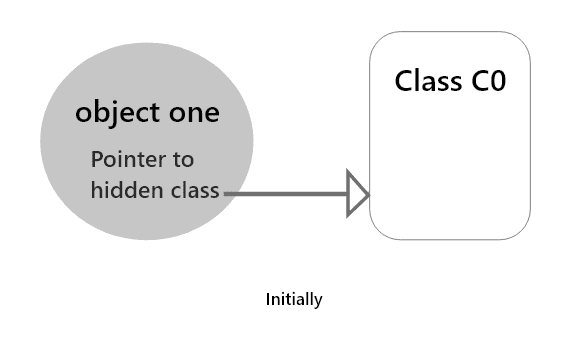
When the Person function gets invoked to initialize the object one hidden class related to the object one gets created. Consider it as C0. initially, C0 is an empty class after an invocation as it does not contain any properties. (refer below diagram)
But when this.name = name executed another class C1 gets created containing memory offset of name variable. So initially object one pointing to C0 but now it’s pointing to C1. and a condition called transition is gets added to C0 stating if you add the property name in the object then the new hidden class is C1. (refer below diagram)
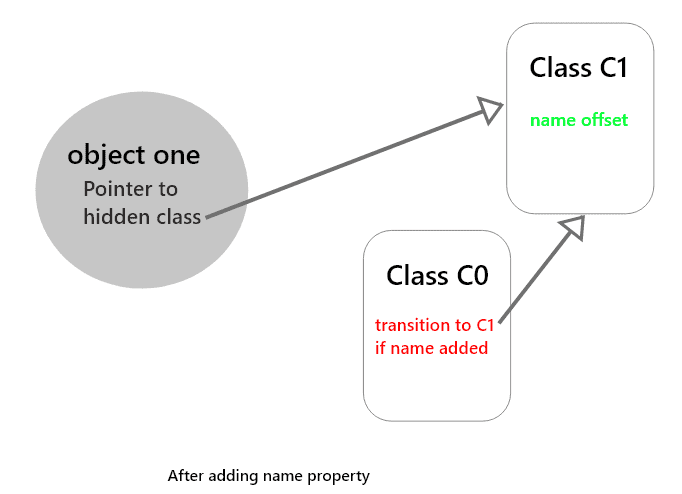
Now when another object two is initialized by invoking the Person function. It is going to use the same hidden class initially i.e. C0. but later the property name is added it will see transition condition in C0 that if the name added refer to C1. So now object two also point to the hidden class C1.
Currently both one and two objects using the same hidden classes. As both have the same properties.
Next if we add one more property to one object like below.
one.age = 25;The new hidden class C2 gets created and it contains offset for name and age property and transition condition gets added to C1 that if age added go to class C2. (refer below diagram)
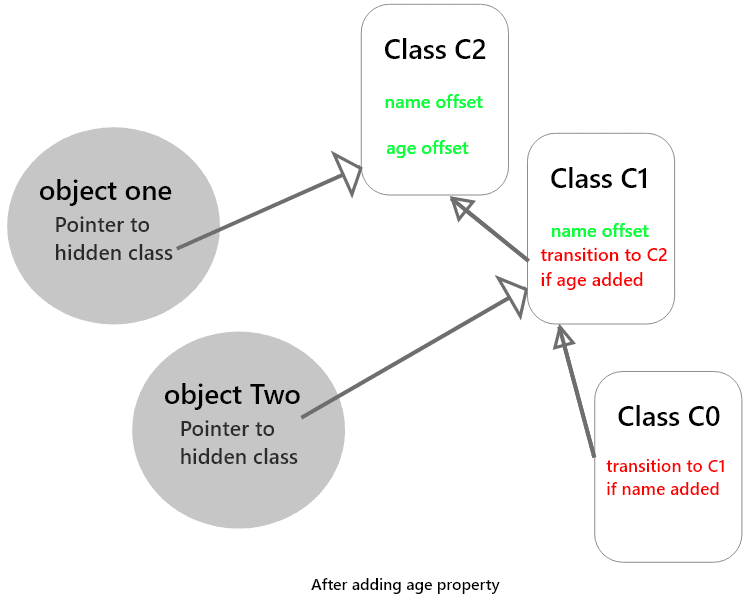
Till now it’s ok as each object pointing to the respective hidden class but we add properties randomly managing hidden classes become difficult and our code gets deoptimized.
We can avoid this by adding properties in the same order for each object so that hidden classes can be shared and code can be optimized. Always assign all of an object’s properties in its constructor.
2. Inline Caching: Inline caching relies upon the observation where repeated calls made to the same function with the same type of object. In such cases, the V8 engine maintains a cache of objects that were passed to function as a parameter previously. Depending upon previous computation engine makes predictions about the type of objects going to pass to the function in the future. If the engine able to make a correct prediction the process of accessing object properties is avoided and directly previous stored information about objects hidden class are given. This will increase the speed of execution. To work Inline caching it is also important that objects of the same type that uses the same hidden classes. If that’s not the case engine will not able to access properties as different hidden classes assign different offsets to their properties.
function printName(user) {
  return `My name is ${user.firstName} ${user.lastName}`
}

const user = {
  firstName: 'Fname',
  lastName: 'Lname'
}

printName(user)

//Result: My name is Fname Lname
If we called printName() with same user object multiple time the result My name is Fname Lname get inline cached.